
Taiwan scooter license practice test: 50 questions
50 multiple-choice questions taken from the Highway Bureau's published written-test bank and hazard-perception questions. You see the correct answer and its explanation after each question, and your score at the end. No download, no sign-up.
- 50 multiple-choice questions
- Pass at 85
- 15 hazard perception questions
How it is scored
- The real written test has 50 multiple-choice questions and a pass mark of 85; 15 of them are hazard perception. Sources (in Chinese): MVDIS news, Taipei Motor Vehicles Office.
- Here every question is worth 2 points, 100 in all: 43 correct answers reach 85.
- This practice test is not the official test: it is always the same 50 questions and has no time limit. Which questions the real test asks is up to the motor vehicles office.
Start
Question 1 of 50Correct Concepts and Attitudes
For a driver tested for alcohol concentration while driving a car, the breath alcohol concentration must not reach or exceed:
Show the answer
Correct answer: 1. 0.15 mg per liter
Explanation: By regulation, a breath alcohol concentration of 0.15 mg per liter or more constitutes drunk driving, and driving is legally prohibited.
Question 2 of 50Correct Concepts and Attitudes
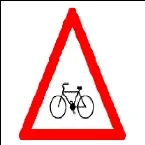
Look at the picture and choose the correct answer
Show the answer
Correct answer: 1. Beware of bicycles
Explanation: This red-bordered white triangle warning sign with a bicycle symbol in the centre indicates 'Beware of bicycles', prompting drivers to watch for bicycles being pushed, crossing, or ridden.
Question 3 of 50Hazard Perception
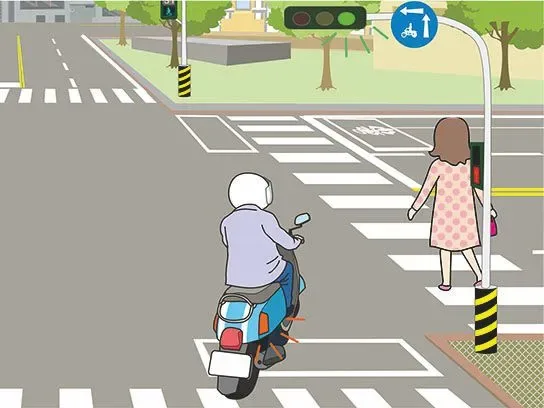
According to the diagram, how should the motorcyclist travel when making a right turn?
Show the answer
Correct answer: 1. Stop the motorcycle and let pedestrians go first before traveling
Explanation: When turning across a pedestrian crossing, motorcyclists must stop and yield to crossing pedestrians, and never honk to rush them or cut across, to ensure safety.
Question 4 of 50Correct Concepts and Attitudes
The height of items carried on a motorcycle must not exceed the driver's
Show the answer
Correct answer: 2. shoulder
Explanation: Items carried on a motorcycle must not exceed the driver's shoulder to avoid obstructing vision or raising the center of gravity, which compromises riding balance and safety.
Question 5 of 50Safe Driving Skills
When riding a motorcycle on a road where the inner lane is marked "No Motorcycles Allowed", how should you make a left turn?
Show the answer
Correct answer: 2. Perform a two-stage left turn
Explanation: When the inner lane prohibits motorcycles, riders cannot make a direct left turn and must proceed to the waiting area to perform a two-stage left turn for safety.
Question 6 of 50Hazard Perception
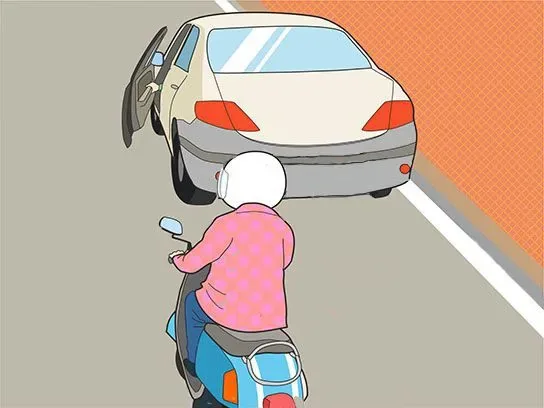
In the diagram, how should the motorcyclist travel safely?
Show the answer
Correct answer: 3. Slow down and keep a door's distance away from the vehicle at the roadside
Explanation: When passing roadside vehicles, slow down and keep a door's distance away from the vehicle at the roadside to prevent collisions if a door suddenly opens.
Question 7 of 50Proactive Yielding Culture
Regarding the concept of vehicle off-tracking (inner wheel difference), which of the following is incorrect?
Show the answer
Correct answer: 1. Passenger cars do not have off-tracking
Explanation: All vehicles produce off-tracking when turning. Passenger cars have shorter wheelbases and smaller off-tracking, but they are not completely without it.
Question 8 of 50Correct Concepts and Attitudes
When carrying cargo on a motorcycle, what is the maximum width allowed for the load?
Show the answer
Correct answer: 1. It must not exceed 10 centimeters beyond the outer edge of the handlebars
Explanation: The cargo width must not exceed 10 centimeters beyond the outer edge of the handlebars to prevent collisions when turning, overtaking, or passing oncoming vehicles.
Question 9 of 50Hazard Perception
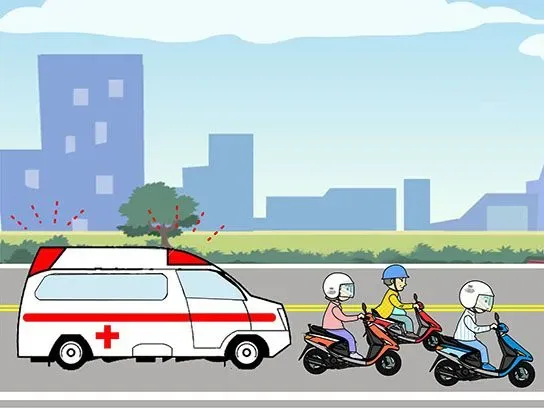
In the diagram, how should the motorcyclists travel safely?
Show the answer
Correct answer: 2. Move to the right side immediately to let the ambulance pass first
Explanation: When encountering an ambulance on duty, slow down and move to the right side immediately to let the ambulance pass first to ensure life-saving efficiency and safety.
Question 10 of 50Safe Driving Skills
The speed of a motorcycle shall comply with the speed limit signs or markings. If there are no speed limit signs or markings, the driving speed shall not exceed
Show the answer
Correct answer: 1. 50 km/h
Explanation: On general roads with mixed traffic, a speed limit of 50 km/h balances traffic flow and braking safety, while 40 or 30 km/h is usually reserved for slow lanes or narrow alleys.
Question 11 of 50Correct Concepts and Attitudes
When driving downhill:
Show the answer
Correct answer: 2. you must not turn off the engine and coast in neutral
Explanation: Turning off the engine or coasting in neutral downhill eliminates engine braking, which can overheat the brakes, cause brake failure, and create severe hazards.
Question 12 of 50Correct Concepts and Attitudes
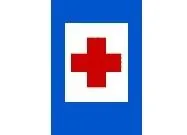
Look at the picture and choose the correct answer
Show the answer
Correct answer: 2. Ambulance station
Explanation: A red cross inside a white box on a blue background indicates an "Ambulance station", used to guide people to a first-aid station or health clinic.
Question 13 of 50Hazard Perception
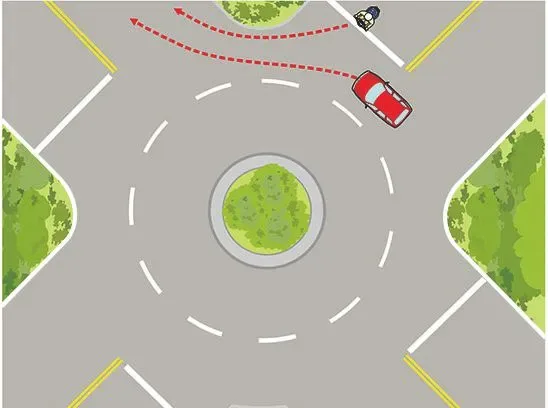
In the diagram, how should the motorcyclist travel safely?
Show the answer
Correct answer: 1. Let the vehicle in the loop pass first and enter the loop afterwards
Explanation: When entering the loop, yield to vehicles already traveling in it. To ensure safety, the motorcyclist should pause to let the red car pass before entering.
Question 14 of 50Correct Concepts and Attitudes
Regarding safety helmet precautions, which of the following statements is incorrect?
Show the answer
Correct answer: 1. A helmet that has been subjected to impact can still be used normally if the exterior shows no damage, without replacement
Explanation: Once a helmet has sustained an impact, its internal shock-absorbing structure may be damaged and lose protective capability, so it must be replaced immediately even if there is no visible exterior damage.
Question 15 of 50Safe Driving Skills
Before entering a curve, a motorcycle should:
Show the answer
Correct answer: 2. appropriately reduce speed
Explanation: You must "appropriately reduce speed" before entering a curve to prevent excessive centrifugal force from causing skidding, loss of control, or lane deviation, ensuring safe turning.
Question 16 of 50Hazard Perception
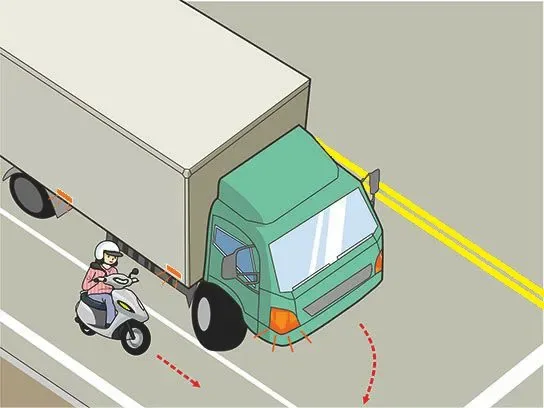
According to the diagram, what should the motorcyclist do to travel more safely?
Show the answer
Correct answer: 2. Slow down and move away from the large vehicle and let the large vehicle go first
Explanation: When turning, large vehicles have blind spots and a difference in the turning radius between front and rear wheels; slow down, keep a safe distance, and let them go first to avoid being squeezed.
Question 17 of 50Proactive Yielding Culture
When riding a motorcycle next to a large vehicle, how should you ride?
Show the answer
Correct answer: 2. Avoid riding side by side with large vehicles and keep a sufficient safe distance
Explanation: Large vehicles have blind spots, inner wheel differences, and airflow effects. For safety, avoid riding side by side with large vehicles and keep a sufficient safe distance.
Question 18 of 50Correct Concepts and Attitudes
Regarding the statement "using a mobile phone while riding a motorcycle or while stopped at a red light," which of the following is correct?
Show the answer
Correct answer: 3. Doing so causes distraction and is an incorrect and dangerous behavior
Explanation: Using a mobile phone while riding or stopped at a red light easily distracts attention and prevents timely reactions to road conditions, making it dangerous and prohibited by law.
Question 19 of 50Hazard Perception
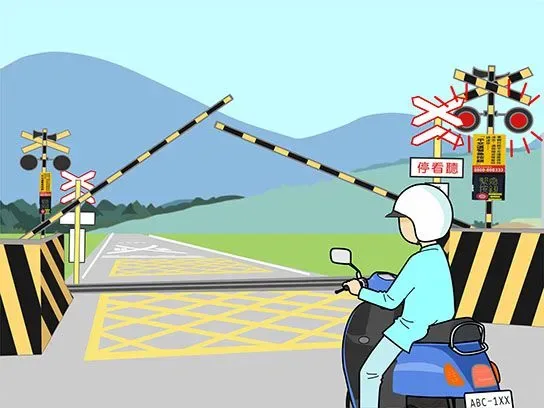
In the diagram, how should the motorcyclist travel safely?
Show the answer
Correct answer: 1. Slow down and stop behind the railroad crossing gate
Explanation: When the crossing alarm sounds, lights flash, and the gate is lowering, you must slow down and stop behind the railroad crossing gate and never force your way through.
Question 20 of 50Safe Driving Skills
When changing lanes, to prevent danger caused by your own blind spots, you should:
Show the answer
Correct answer: 1. Signal in advance, check rearview mirrors, and turn your head to look
Explanation: Before changing lanes, you must signal in advance, check rearview mirrors, and turn your head to look for vehicles in your blind spots to ensure safety.
Question 21 of 50Correct Concepts and Attitudes
According to regulations, can a driver under 18 years old ride a motorcycle?
Show the answer
Correct answer: 1. Under no circumstances can they ride a motorcycle
Explanation: You must be at least 18 years old to obtain a motorcycle license. Minors are strictly prohibited from riding a motorcycle, even with a guardian's consent.
Question 22 of 50Safe Driving Skills
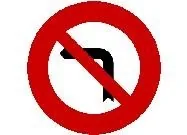
Look at the picture and choose the correct answer
Show the answer
Correct answer: 2. No left turn
Explanation: This sign features a red circle and diagonal slash over a left-turning black arrow, indicating "No left turn" to warn vehicles that turning left is prohibited here.
Question 23 of 50Hazard Perception
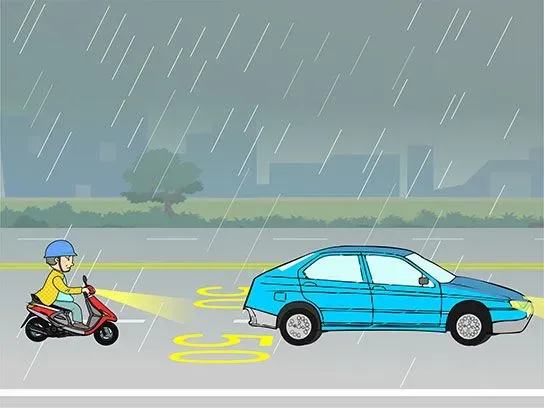
In the diagram, how should the motorcyclist travel safely in these conditions?
Show the answer
Correct answer: 2. Slow down and keep a longer safety distance from the vehicle in front because of the slippery road
Explanation: In rainy weather, roads are slippery, visibility is poor, and braking distance increases. For safety, drivers should slow down and keep a longer safety distance from the vehicle in front.
Question 24 of 50Correct Concepts and Attitudes
When discovering someone unconscious, what is the primary action?
Show the answer
Correct answer: 2. Check the patient's level of consciousness and pulse
Explanation: When finding an unconscious person, first evaluate and confirm their level of consciousness and vital signs before deciding whether to call for help, perform CPR, or use an AED.
Question 25 of 50Safe Driving Skills
When a motorcycle rider changes lanes or turns in accordance with regulations, how many meters before the intersection or turning point should the turn signal be activated?
Show the answer
Correct answer: 3. 30 meters before
Explanation: You must activate your turn signal 30 meters before turning or changing lanes to give surrounding vehicles enough time to react safely.
Question 26 of 50Hazard Perception
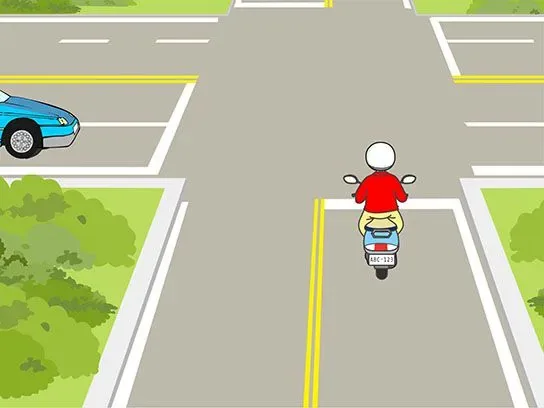
According to the diagram, how should the motorcyclist travel more safely?
Show the answer
Correct answer: 1. Slow down and stop to let the vehicle pass first
Explanation: When approaching an unsignalized intersection, vehicles on a road with fewer lanes must yield to vehicles on a road with more lanes. The motorcyclist must slow down and stop to let the vehicle pass first.
Question 27 of 50Proactive Yielding Culture
When a motorcycle rider notices an ambulance performing an emergency mission, what should they do?
Show the answer
Correct answer: 3. Yield to the ambulance and do not overtake it
Explanation: You must yield and never follow closely or overtake an ambulance on an emergency mission, keeping the emergency route clear and ensuring safety.
Question 28 of 50Correct Concepts and Attitudes
After marking the positions of relevant evidence on the ground following an accident, under which of the following circumstances should the vehicle be immediately moved to the roadside to avoid obstructing traffic?
Show the answer
Correct answer: 1. Minor accident with no injuries or fatalities
Explanation: For a "Minor accident with no injuries or fatalities", vehicles must be promptly moved to the roadside after marking positions to prevent obstructing traffic and avoid secondary accidents.
Question 29 of 50Hazard Perception
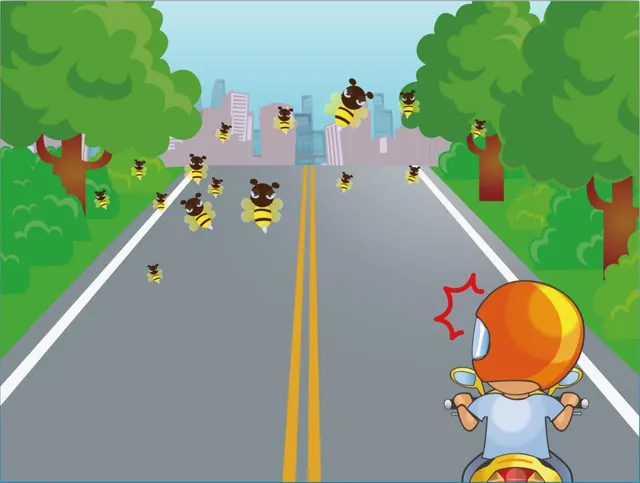
According to the picture, when encountering bees, what should the rider do to ride safely?
Show the answer
Correct answer: 1. Take a detour or back away, and avoid large movements
Explanation: Stay calm when you meet a swarm of bees: take a detour or back away. Large movements, or trying to wave the bees away, can provoke them to attack.
Question 30 of 50Safe Driving Skills
When riding a motorcycle inside a tunnel:
Show the answer
Correct answer: 3. headlights should be turned on and ride slowly
Explanation: Because tunnels are dim and enclosed, headlights should be turned on to improve visibility, and riders must slow down to maintain safety.
Question 31 of 50Correct Concepts and Attitudes
The higher the speed, the parking distance is:
Show the answer
Correct answer: 3. longer
Explanation: The faster you ride, the more ground you cover while reacting and while braking, so the stopping distance (called the "parking distance" in this question) is longer.
Question 32 of 50Correct Concepts and Attitudes
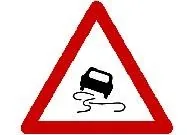
Look at the picture and choose the correct answer
Show the answer
Correct answer: 2. Slippery road
Explanation: This triangular warning sign shows a skidding car with tire tracks, warning drivers of a "Slippery road" ahead where they should slow down.
Question 33 of 50Hazard Perception
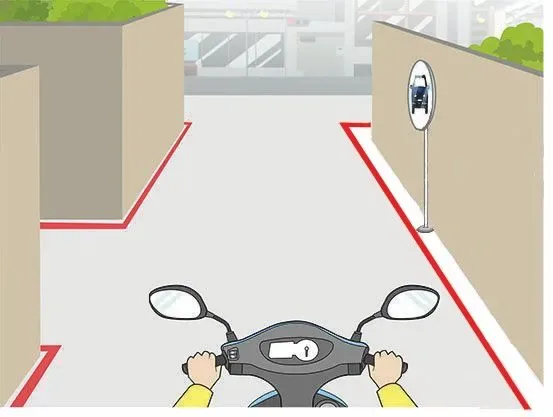
In the diagram, when traveling through the alley, how should the motorcyclist travel safely?
Show the answer
Correct answer: 2. Slow down and observe the reflector and check whether there is a vehicle arriving from the left
Explanation: When approaching an unsignalized alley intersection with obstructed views, slow down, observe the reflector, and turn your head to check for approaching traffic from both sides to ensure safety.
Question 34 of 50Correct Concepts and Attitudes
A person holding a heavy motorcycle driver's license is permitted to drive
Show the answer
Correct answer: 1. a light motorcycle
Explanation: Holders of a heavy motorcycle driver's license are permitted to ride a light motorcycle, but are not allowed to drive automobiles such as a small passenger car or a small truck.
Question 35 of 50Safe Driving Skills
When riding a motorcycle, what safe distance should be maintained from parked vehicles on the roadside to avoid sudden hazards (e.g., car doors opening)?
Show the answer
Correct answer: 2. Keep at least 1 meter (about the width of a car door) or more
Explanation: Maintaining a safe distance of at least 1 meter effectively protects against suddenly opened car doors or dashing pedestrians, providing sufficient space to react.
Question 36 of 50Hazard Perception
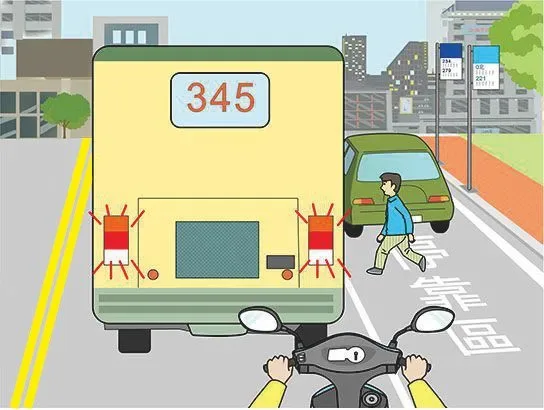
In the diagram, how should the motorcyclist travel safely?
Show the answer
Correct answer: 3. Wait until the bus leaves and continue travelling
Explanation: Because the double yellow lines on the left prohibit crossing and a pedestrian is crossing on the right, stay safely behind and wait until the bus leaves and continue travelling.
Question 37 of 50Proactive Yielding Culture
When riding and noticing a large vehicle ahead signaling a right turn, how should the motorcyclist respond?
Show the answer
Correct answer: 2. Slow down and keep a distance behind the large vehicle, avoiding entering its right-side blind spot
Explanation: A large vehicle turning right cuts the corner with its rear wheels, and its driver cannot see much on the right side. Slow down and stay well behind it; never overtake on its right or follow closely beside it.
Question 38 of 50Correct Concepts and Attitudes
While riding, if you suddenly feel fatigued and sleepy, which of the following actions is correct?
Show the answer
Correct answer: 1. Look for a suitable place to stop and rest, and resume riding after your alertness has recovered
Explanation: Fatigued riding significantly reduces attention and reaction capabilities, easily causing danger. When feeling tired, you should rest in a safe place before resuming riding.
Question 39 of 50Hazard Perception
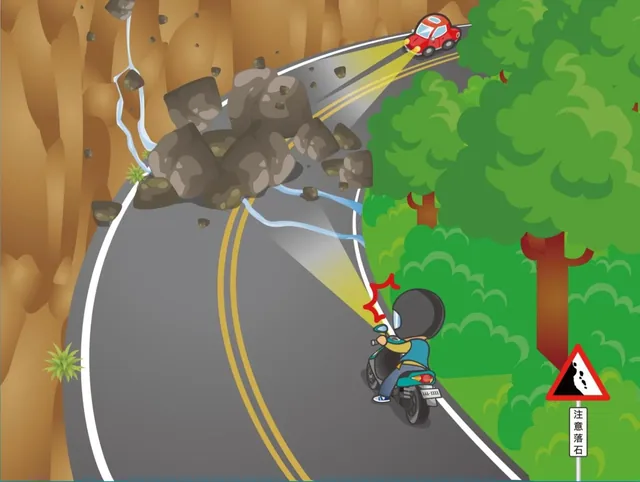
According to the picture, what should the rider do to ride safely?
Show the answer
Correct answer: 2. Check or take other routes
Explanation: Falling rocks block the road and may continue to fall. Never risk passing through or removing them yourself; instead, check or take other routes.
Question 40 of 50Safe Driving Skills
To avoid dazzling drivers of oncoming vehicles at night, how should a motorcycle rider use the lights when meeting another vehicle?
Show the answer
Correct answer: 1. Use the low beam
Explanation: Switching to the low beam when meeting oncoming vehicles at night prevents glare from dazzling other drivers, ensuring safety for both parties.
Question 41 of 50Correct Concepts and Attitudes
When a motorcycle rider causes an accident resulting in injury to another person, which of the following statements regarding the priority order of on-site handling is correct?
Show the answer
Correct answer: 2. The rider should immediately provide first aid to the injured person and notify the fire department, while simultaneously marking the scene as required and reporting the accident to the police
Explanation: Human life and safety are the top priority. When an accident results in injury, immediately provide first aid and call for an ambulance, while also marking the scene and reporting the accident to the police.
Question 42 of 50Correct Concepts and Attitudes
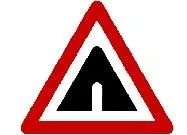
Look at the picture and choose the correct answer
Show the answer
Correct answer: 2. Tunnel
Explanation: This red-bordered triangle with a black tunnel shape and road is a warning sign that indicates a tunnel ahead, reminding drivers to slow down and turn on headlights.
Question 43 of 50Hazard Perception
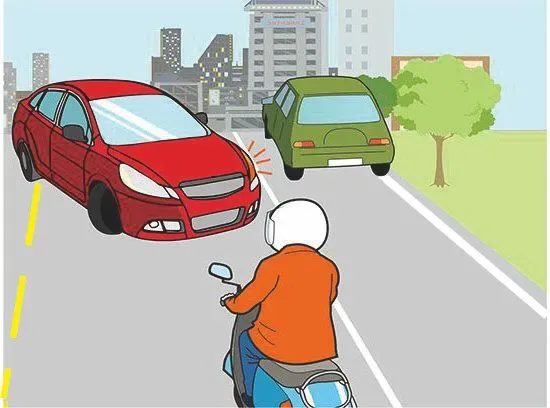
In the diagram, if the motorcyclist experiences the situation ahead, what is the safest way to proceed?
Show the answer
Correct answer: 3. Slow down and stop and do not pass the vehicle arbitrarily
Explanation: The red car ahead is crossing the lane with its turn signal flashing, leaving no safe space on either side. Slow down and stop to avoid a collision.
Question 44 of 50Correct Concepts and Attitudes
Regarding right-of-way responsibility during an accident, which of the following is correct?
Show the answer
Correct answer: 3. The turning vehicle must yield to the vehicle going straight
Explanation: Because turning vehicles change direction and cross the paths of straight traffic, rushing easily causes collisions. Therefore, the turning vehicle must yield to the vehicle going straight.
Question 45 of 50Safe Driving Skills
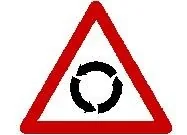
Look at the picture and choose the correct answer
Show the answer
Correct answer: 2. Roundabout
Explanation: This red-bordered white triangle is a warning sign: its three circular arrows warn of a roundabout ahead, so slow down.
Question 46 of 50Hazard Perception
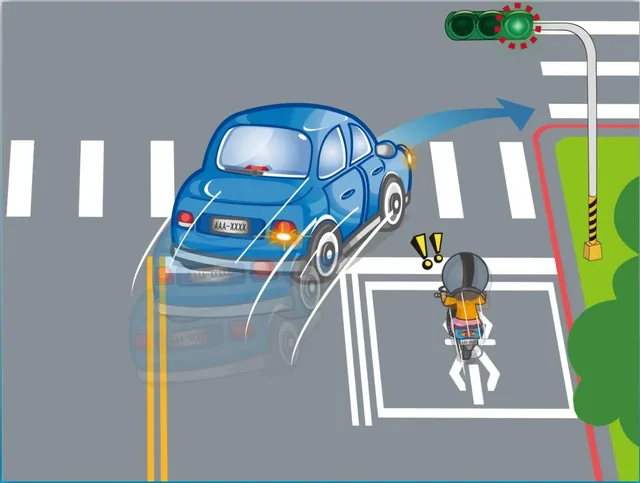
How should the rider ride more safely when passing the intersection?
Show the answer
Correct answer: 3. Speed down and pay attention to the car that violates the rule
Explanation: When a car cuts across lanes to make a sudden illegal right turn, you should speed down and pay attention to the car that violates the rule instead of overtaking to avoid a collision.
Question 47 of 50Proactive Yielding Culture
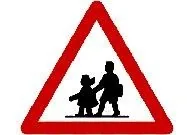
Look at the picture and choose the correct answer
Show the answer
Correct answer: 2. Watch for Children
Explanation: This warning sign featuring schoolchildren inside a red triangle means "Watch for Children," reminding drivers to slow down and watch out for the safety of children.
Question 48 of 50Correct Concepts and Attitudes
When driving in rural areas and you encounter a flock of geese crossing the road, you should
Show the answer
Correct answer: 3. slow down and wait for them to pass before proceeding
Explanation: When animals cross the road, you should slow down and wait for them to pass before proceeding. Honking or accelerating can startle them into scattering and create dangerous situations.
Question 49 of 50Hazard Perception
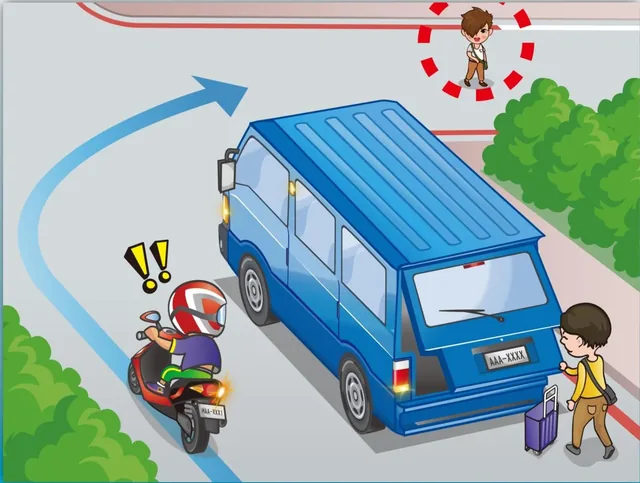
According to the picture, what should the rider do to ride safely?
Show the answer
Correct answer: 3. Speed down and avoid the danger caused by dead angles
Explanation: The van blocks the view and creates dead angles, and pedestrians may be crossing ahead. The rider should speed down to guard against sudden hazards.
Question 50 of 50Correct Concepts and Attitudes
When a motorcycle is waiting to refuel at a gas station,
Show the answer
Correct answer: 1. the engine must be turned off first
Explanation: Because gas stations have high vapor concentrations, sparks or high temperatures from a running engine can easily trigger fires or explosions. For safety, the engine must be turned off both while waiting and while refueling.
Result
The app has the full question bank, the hazard-perception video questions and 50-question mock exams.
Not affiliated with Taiwan's Highway Bureau or any government agency.
Where the questions come from
- The wording and the pictures of the questions and options come from the written-test question bank and the hazard-perception questions published by Taiwan's Highway Bureau. Nothing was rewritten, except one clear translation error: in the hazard-perception question about a swarm of bees, the English and Indonesian text now says what the Chinese original says.
- The explanation after each answer was written by AI and checked against the official answer by a second AI. The official answer is the one that counts.
- The Bureau offers the written-test bank as PDFs in 8 languages: question bank download page.
- For the full bank and the hazard-perception video questions, use the app.
Questions and answers
Is this online practice test free? Do I need an account?
It is free and needs no account. Open this page and start; it works on a phone and on a computer.
Are these the same questions as in the real test?
They come from the same bank, but this is not the official test. It is always the same 50 questions, so you can get to know the question types; which questions the real test asks is up to the motor vehicles office.
What score do I need to pass?
85. Here every question is worth 2 points, so 43 or more correct answers pass.
What comes after these 50 questions?
The app “Taiwan Moto License Test” has the full bank, the hazard-perception video questions, a review of your mistakes and 50-question mock exams. It is free to download.
Want the full question bank?
Download the app and keep practicing.